Trends
Programming Civic Spaces for Long-Term Success
November 17, 2026
Long-term success requires more than physical design. It depends on programming, community involvement, and a clear grasp of how different people experience the same place.
What are intergenerational public spaces?
Intergenerational public spaces are designed and programmed so that children, working-age adults and older people can use the same place at the same time, with features that encourage positive contact rather than mere co-location. They combine complementary activities, quiet and active zones, and shared facilities such as play areas beside seating or childcare near senior services.
Designing for social cohesion and shared experience
Many public spaces still divide people by age. Playgrounds sit apart from seating, youth facilities are kept separate from older people’s amenities, and buildings are planned around single-purpose activities. While dedicated spaces remain important, excessive separation can limit the informal contact that helps communities become more connected.
Case Study: Heartbeat@Bedok
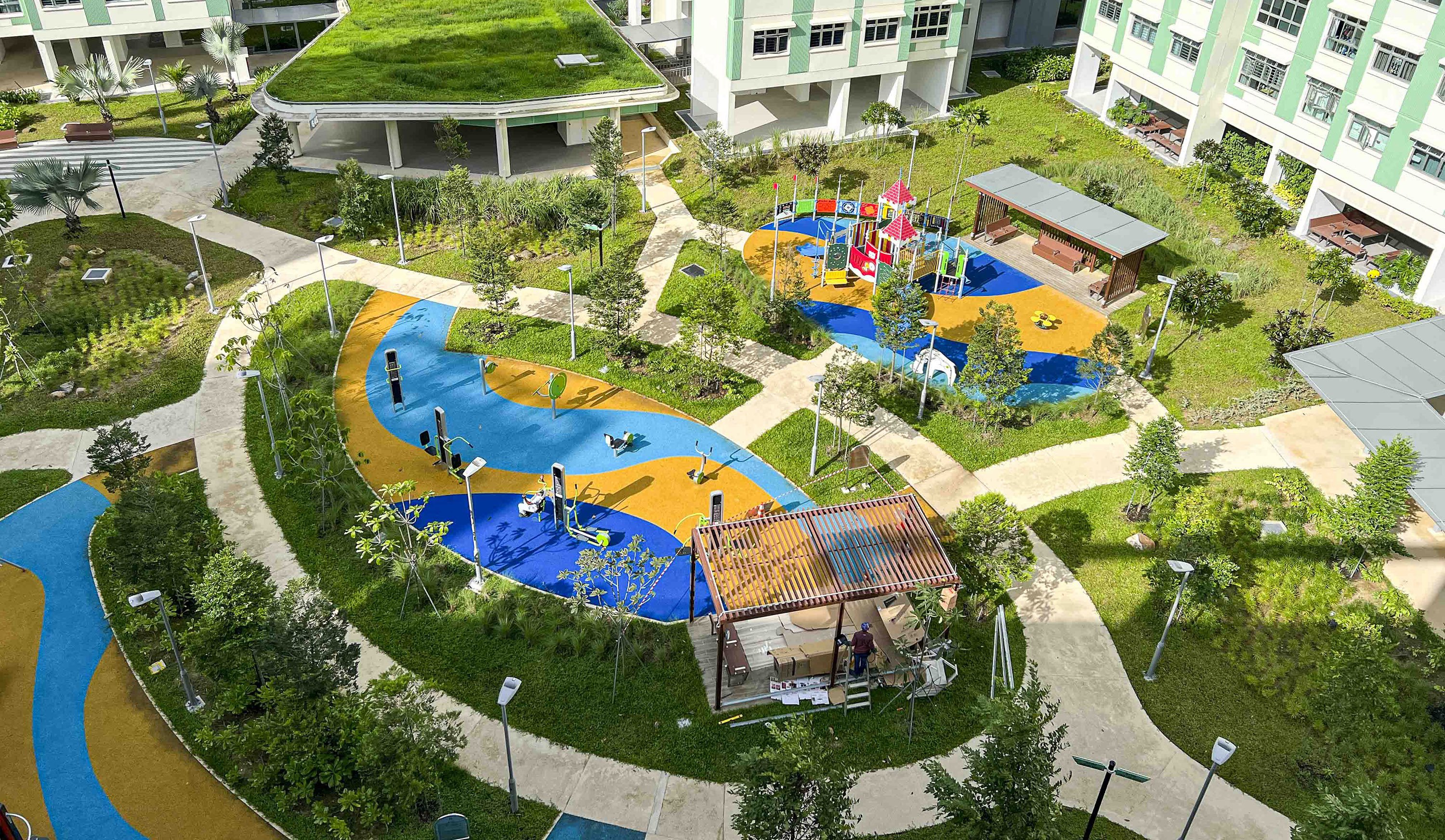
Intergenerational community spaces, such as Heartbeat@Bedok, let different age groups share one environment without forcing them into the same activity. A child can attend pre-school while a grandparent stops by the polyclinic for a health check. Schoolmates can visit the library while families enjoy dining at the eateries. Young people can use the sports facilities in the evening while others join a community event. Adjacent facilities and shared routes make contact possible. Independence remains a choice: join in, watch from the side, or find a quieter spot.
Programming is equally important. A space may include excellent physical infrastructure, but without regular activities it can remain underused or feel inaccessible to parts of the community. Local events, shared meals, outdoor learning, exercise sessions and cultural activities can help people become familiar with one another and develop a sense of ownership.
What is universal design in public spaces?
Universal design creates environments usable by people of all ages, abilities and sensory needs without specialised adaptations. It goes beyond legal minimums, such as ramps and tactile paving, to include intuitive wayfinding, mixed seating and multi-sensory cues, so a space feels welcoming rather than merely compliant.
A universally designed place lets people arrive, move, pause, take part and leave without being separated from everyone else. Accessibility should shape routes, materials, lighting and the location of facilities from the start, not as a late technical fix. For Heartbeat@Bedok, universal design was built into the brief, and the completed community hub received Singapore’s Universal Design Mark GoldPlus.These decisions help more than a narrow group of users. Parents with young children, people recovering from illness, older residents and anyone carrying bags or equipment all move more easily when rest and circulation are designed together. Universal design is not a separate experience for a minority. It is a better baseline for everyone, and a matter of civic dignity rather than an obligation.
Testing temporary interventions
Temporary interventions act as live prototypes. Communities can try a space before major construction begins. Planners can watch how people use low-cost, flexible installations, then let that evidence shape the permanent scheme instead of relying on assumptions.
Temporary work must, however, be carefully planned. It should not replace essential infrastructure, and it should not leave residents to test ideas without support. People need a clear purpose for the trial, a way to contribute, and proof that feedback will affect the next stage.The strongest process is often hybrid. Temporary measures test the idea. Permanent investment then supplies the infrastructure needed for comfort and resilience.
Successful elements can be retained, improved or expanded. Less effective ideas can be changed before they become embedded in the physical fabric of the place..
Programming as an ongoing civic commitment
Public spaces succeed when they are treated as living systems rather than finished objects. Intergenerational design supports connection. Universal design widens who can take part. Temporary interventions create opportunities to listen, learn and adapt before permanent decisions are made.
Nonetheless, design alone is insufficient. Public spaces need maintenance, stewardship and ongoing programming. Their uses will change as communities grow older, new residents arrive and local needs evolve. A successful space is therefore not one that remains unchanged, but one that can continue to serve people with care and flexibility.The priority should be clear: create public spaces that people can access, shape, share and recognise as their own. When human experience leads the process, the result is not simply a better-designed place. It is stronger civic infrastructure for generations to come.